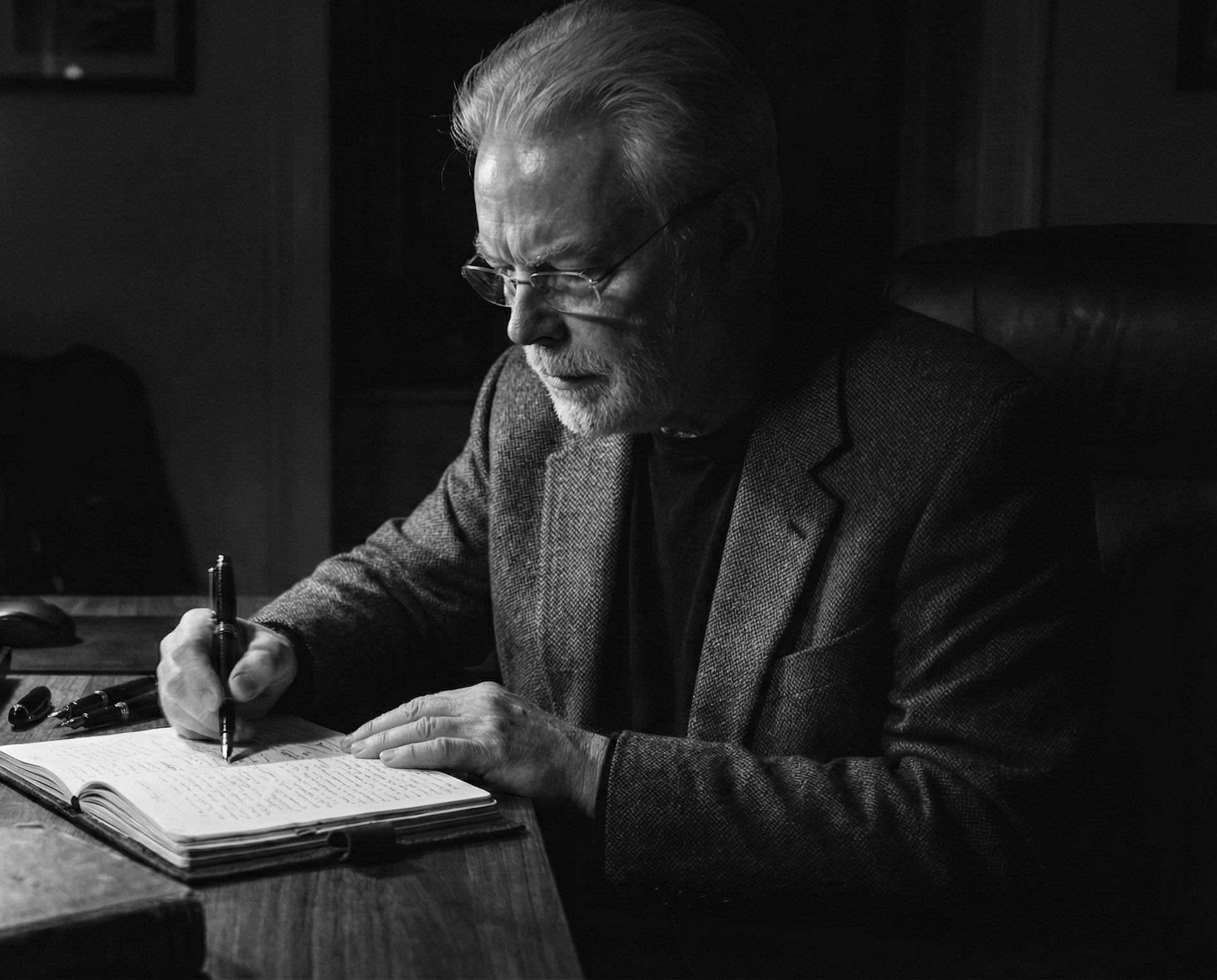
About the Author
Fifty years watching how systems work. And what they conceal.
“The systems in these novels are real. The surveillance architecture is real. The institutional behaviour is real. The only thing that is fiction are the names.”
Ken Swayne did not come to writing through an English degree or a literary career. He came through fifty years at the frontier of technology, and through a life that took him further than most professional biographies go.
He grew up in Alderley Edge, Cheshire — on the escarpment that appears, in various forms, in his fiction. He has never been entirely sure whether the landscape shaped the writing or the writing clarified what the landscape meant. Probably both.
The specific quality his technology background brings to his fiction is not research. It is recognition — the difference between knowing how surveillance architecture works from reading about it, and having built versions of it himself.
But the books are not primarily about technology. They are about the moment hidden knowledge becomes impossible to ignore. And that is a biographical fact as much as a professional one. In 1986, Ken Swayne was present at the Manila Hotel during the coup attempt against the Aquino government — coordinating the evacuation of a large Australian contingent through service exits while armed rebels moved through the building. The knowledge that power operates invisibly until it doesn’t, that institutions conceal what they most need to protect, that ordinary people get caught in systems they never knew existed — this is not something he extrapolated from public events. He was in the room.
Twenty-Two Years in Australia
In the 1970s, Ken Swayne moved to Western Australia. He stayed for twenty-two years, running his own design and visualisation studio with clients including broadcast, communications, manufacturing, engineering and mining companies across the country.
We are all inundated with data, it’s growing exponentially, and we are built to work the world in three dimensions. Visualising that data, when we ‘see it’, the information all makes sense, suddenly it’s understandable. And the more beautiful the 3D render appears, the more acceptable and forgiving our perceptions are.
The Return and the Writing
Ken Swayne returned to the United Kingdom in 1995 and continued working in technology through the development of advanced 3D graphics, early VR and AR systems. He began writing fiction in his early seventies, not as a retirement project but as the natural direction of a mind that had spent fifty years accumulating knowledge about how systems work and what they conceal.
The novels are not what I imagined writing would look like when I started. They are what fifty years of building technology turns into when you finally have the time and the distance to understand what you were building.
Present at the Manila Hotel during the Tolentino coup attempt against the Aquino government. Coordinating the evacuation of a large Australian contingent through service exits while armed rebels moved through the building. The knowledge that institutional power operates through concealment until the moment it cannot — this is where the fiction begins.
Informs: AMBIENT · The Divine Constant
Twenty-two years running a design and visualisation studio. Engineering and mining clients across the country.
Informs: The Divine Constant
Early VR and AR systems. 3D visualisation in science, architecture and engineering.
Informs: The Leonardo Codex Thrillers
Fifty years watching data infrastructure embed assumptions invisibly. Not research — recognition.
Informs: Unchanged — The Divine Constant
The Publishing Decision
The honest answer is that these four novels explored the traditional route first. Query letters were written carefully, synopses prepared, and agents approached. It is a process that asks a great deal of a writer — patience, persistence, a willingness to hear a great deal of silence. And it is one that Ken went through with genuine respect for literary agents and publishers.
The decision to publish through Amazon KDP came from a simple recognition: the books were finished, the catalogue argument was complete, and the readers were already out there. Self-publishing in 2025 is a well-supported route to market. The production values, the reach, and the direct relationship with readers it enables made it feel like the right fit for this set of books right now.
There is also something fitting about a writer whose entire professional life was spent at the frontier of new technology choosing to publish through a platform that has genuinely changed who gets to reach readers, and how. Amazon KDP is just a different door — and it turned out to be the one that was already open.
“The books were always going to find their readers. This is simply the most direct route.”